Behind every death are lives left to cope
Tammy Curtis, Publisher
Editor’s Note:
When we put out a call for people affected by suicide to share their experiences for this article, the response was overwhelming: 58 people answered.
Space constraints made it impossible to include every story, though we wish we could. The sheer number of responses speaks to the impact suicide has had on people living in our communities.
For this article, we chose several perspectives, including those of people who have lost loved ones to suicide, a suicide attempt survivor, someone living with mental health struggles, a longtime teacher who has experienced the suicides of three students and the mother of a suicide attempt survivor.
It is our sincere hope that something within these stories helps save a life.
We also hope parents and other adults will pay attention to what children are hearing and experiencing, check on them regularly and learn to recognize possible signs of depression and emotional distress. For adults who may be struggling themselves, we hope these stories serve as a reminder that help is available and that circumstances that feel unbearable today can change.
Suicide also leaves a lasting impact on those left behind — family members, friends, classmates, teachers and entire communities.
Names have been changed where necessary to protect the identities of those who shared their stories.
58 LOCAL VOICES…When the Spring River Chronicle asked local residents affected by suicide to share their experiences, 58 people responded.
Suicide claimed the lives of 626 Arkansans last year, a rate of approximately 19 deaths per 100,000 residents. It is the leading cause of violent death in Arkansas. Statistics compiled by the Arkansas Department of Health show the state’s suicide rate remains significantly higher than the national rate.
Mental Health America’s State of Mental Health in America report also places Arkansas among states struggling with both the prevalence of mental illness and access to care.
Those challenges can be especially pronounced in rural communities, where access to mental health professionals and treatment may be limited.
Sharp and Fulton counties have experienced at least nine suicides in 2026.
Behind each number is a person. And surrounding each person are others whose lives are forever changed.
For Suicide Prevention Month, some of those people agreed to speak.
A teacher carrying the loss of three students
For teachers, the suicide of a student does not end when students return to class.
“Carla,” a longtime high school teacher, has experienced the suicides of three students during her career. The past several years have been among the most difficult, she said, and at times she has considered leaving education altogether.
Carla believes she began seeing significant changes in students’ mental health and behavior following the COVID-19 pandemic. In her experience, increased time online, social media and exposure to troubling content have contributed to some of the behaviors she sees in the classroom.
She also believes some young people lack trusted adults with whom they feel comfortable discussing their problems. Adults may unintentionally minimize a teenager’s struggles, she said, particularly if they were raised with the attitude that difficult emotions should simply be endured.
When a young person feels dismissed, she believes that child may become less willing to confide in an adult as depression or isolation deepens.
In her experience, Carla said students who seek help from counselors are often better positioned to receive the support they need. She also cautioned that bullying situations can be complicated and may not always be as they initially appear.
“People want to talk about how mean kids are, they learn it somewhere, they will gaslight you and put you in the corner. This causing stress so these people can’t defend themselves and they feel the only way out is death.”
Of the three students Carla lost, she remembers recognizing warning signs in one. With the other two, she did not.
She said confidentiality requirements can also leave teachers uncertain about how best to help students returning to school after receiving mental health treatment. Teachers may know something has changed, she said, without knowing what the student has experienced.
“Even after the fact you can reprocess and analyze. You can starting looking at every day and mood and the last tests and grades.. It is hard to distinquish between normal teenagers or depresssed or suicidal teenagers. While we have great counselors but if teachers had foreknowledge, I feel it would help more. We seen them on daily basis. We know what is not normal. If we feel something wrong, we can ask and if they say fine, I will have the counselor also talk to them,” she said. “It is a double edged sword, by law you can only know so much.”
The loss also takes a toll on teachers themselves.
After a student dies, educators must process their own grief while returning to classrooms filled with young people who may also be grieving, frightened or struggling with their own mental health.
“It is very hard to sit here and put on a happy face and try to be encouraging to these kids becaue you are going through the same things and knowing these kids home lives. I just try to love them and some parents don’t want you to care because it reveals their faults. I have one now, She misses a lot for medical reasons. I cussed out for checking on her. I am tired of this, not going to get sued. There is no winning,” she said of the frustration.
When asked what she believes contributes to the mental health crisis among teenagers, Carla pointed to Maslow’s Hierarchy of Needs — the concept that basic needs must be met before people can effectively address higher emotional and psychological needs.
A child may have food, clothing and shelter, she said, while still lacking emotional security or support. In some cases, parents may also struggle to provide emotional support because they never received it themselves.
Carla worries the emotional toll will eventually drive experienced teachers from the profession.
“What will we have then? People just need to know our world has become so hard and the only way to make a difference in this life is to be soft. Hurting people hurt people. Kids learn by example, all they have learned since Covid is hate. if you don’t have anything nice to say don’t say anything at all is the one thing we always come back to.”
“Now I’m thankful I’m here to have a future”
Another person who responded was a teenage boy who survived a suicide attempt.
He agreed to share his experience because of what he understands now that he could not see while he was in crisis.
“I am a teenager, and I survived a suicide attempt. Before it happened, I had gotten to a point where I just didn’t care about anything anymore. I didn’t care about consequences, tomorrow, or even what happened to me. I never really felt like I fit in with any group, and even when I was around other people, I still felt disconnected from everything. What I couldn’t see then was that the way I felt wouldn’t last forever. Now I wake up and actually look forward to things again. I think about my future, the places I want to go, the things I want to experience, and the person I still have time to become. I’ve learned that not every day has to be a great day for life to still be good. Sometimes you just make the best out of the day you have, and tomorrow gives you another chance. If you’re a teenager and you’ve reached the point where you don’t care what happens to you anymore, please tell somebody. You don’t have to know exactly what to say. Just tell someone you’re not okay, and if they don’t listen, tell someone else. There was a time when I couldn’t imagine caring about my future. Now I’m thankful I’m here to have one. I almost gave up everything that was still waiting for me, and I didn’t even know it yet.”
A MOTHER’S
STORY OF
SURVIVING HER SON’S ATTEMPT
His mother said the experience changed their family and exposed how difficult it can be for parents to navigate mental health and other systems when a child is in crisis.
She is now beginning the process of establishing a nonprofit to help other teenagers and families facing similar circumstances.
“I have begun the process to start a non profit to help teens and families dealing with mental health and legal obstacles. This has been a year long ordeal that has taught me, humbled me and made me question so much of how our children are being helped. I didn’t know where to start or ask for help and I’ve learned that nobody in my shoes ever does. We don’t expect these things to happen. But once they do- it changes our lives forever.
I’m just lucky my son survived.”
Warning signs are not
always obvious
Another respondent who has lost loved ones to suicide said her experiences taught her that someone in crisis may not always look the way others expect.
Isolation, depression and self-harm can be warning signs, she said, but her experiences have shown her that outward appearances do not always reveal what someone is experiencing internally.
“It’s the happiest people, people you wouldn’t expect it from. They are people who smile every single day when in public but go home and cry alone. It’s also the people who were depressed and are suddenly happy again to the point where it’s scary. I have depression, anxiety, PTSD, bipolar disorder. My siblings have all told me that it’s when I’m the most happy they worry the most. People who are about to end it all are happy. They’re happy it’s over. Happy the pain is gone. Happy they’re gonna be free again. I almost lost my life to suicide and I’ve lost many people to it. The biggest thing is… check on your people. often. Don’t leave people alone. Just because they’re sad, sometimes they need that extra push to make them feel like life is worth living.”
Her experience underscores one of the difficulties surrounding suicide prevention: No single behavior can tell family members or friends exactly what another person is thinking.
Sometimes the most important thing someone can do is ask.
Making the miles mean something
For Katie Norris, remembering those lost to suicide has taken the form of putting one foot in front of the other.
Norris has lost four family members and friends to suicide. She recently completed her first 10K after initially signing up for the “Your Story Isn’t Over” 5K through The Flex at Pink Company to raise awareness for suicide prevention.
“The event quickly became something much more personal as I have had four family/friends commit suicide including my husbands father so I also wanted to carry on his story and my other family/friends as well.”
Norris reached out through social media to families who had lost loved ones to suicide and offered to carry their names on her shirt during the run.
Fifteen families responded.
“Fifteen families reached out and entrusted me with their loved ones’ names. Although I had signed up for a 5K, I felt moved to challenge myself to run a 10K instead. I had never run a 10K before, but I wanted to make the miles mean something. I ran my first 10K in Houston, Mo., carrying the names of those 15 individuals with me. One of those names was my brother-in-law, who died by suicide. Before his death, the last route he ran was to the gym. I decided to run that same route in his memory. What was supposed to be a 10K ultimately turned into seven miles as I followed his route. Every step was a reminder that behind every name is a family, a story and a life that mattered. This run was about more than a race. It was about remembering those we have lost, supporting the families left behind and reminding anyone who may be struggling that their story is not over.”
Behind every number is a life
Mental illness is often invisible. A person can go to work, attend school, laugh with friends or care for a family while privately struggling.
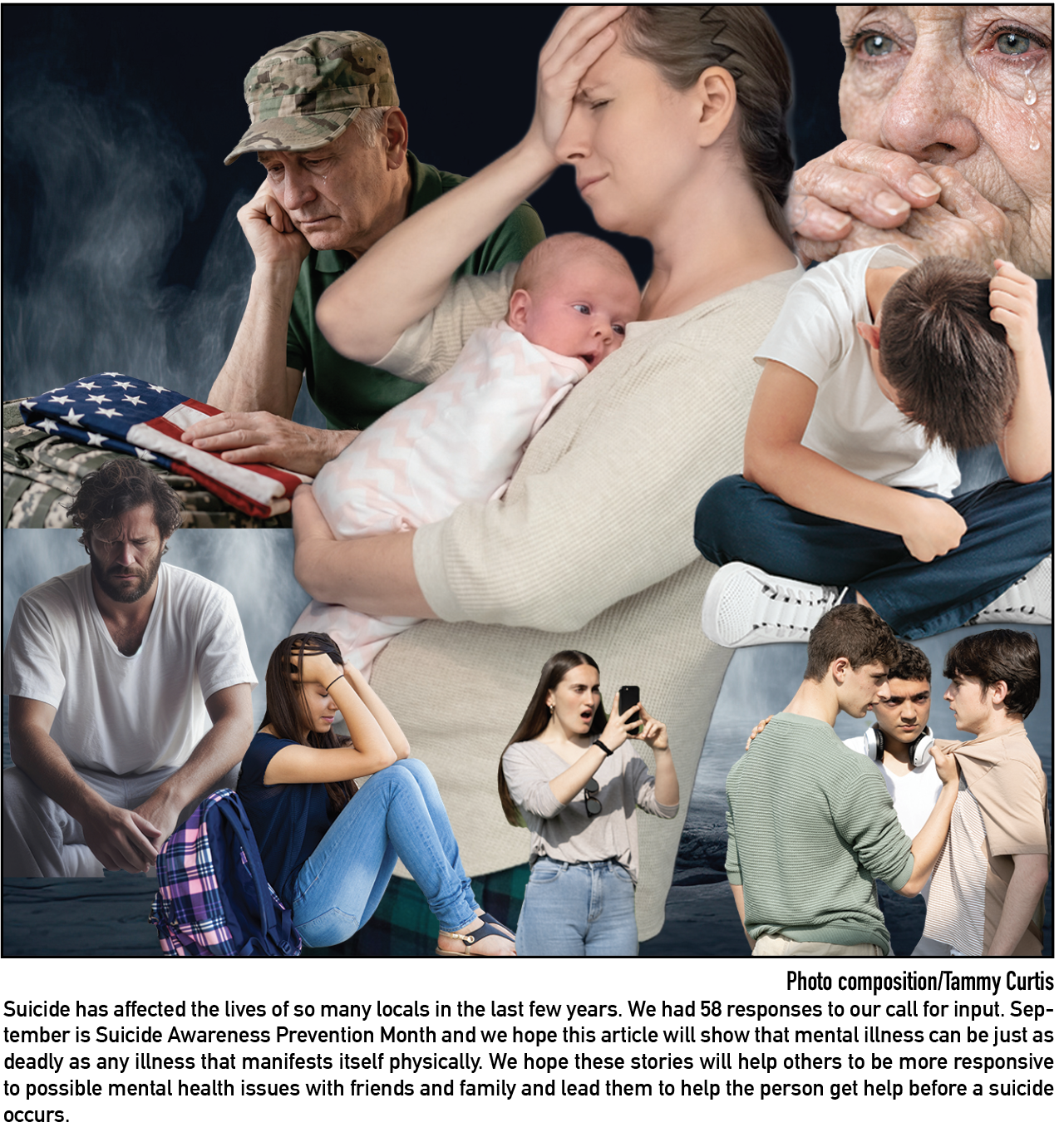
Suicide also crosses age, social and economic boundaries. Locally, its impact has been felt among children, teenagers, new mothers, adults, veterans, law enforcement officers and senior citizens.
That is why compassion matters.
We may never know what another person is carrying.
Checking on someone, listening without immediately judging or minimizing what they are feeling and helping connect that person with professional support may matter more than we realize.
And for the person who is struggling, the message from one local teenager who survived may be the most important one in this story:
There was a time when he could not imagine caring about his future.
Today, he is thankful he is here to have one.
Help is available. Anyone experiencing suicidal thoughts or a mental health crisis can call or text 988 to reach the Suicide & Crisis Lifeline. In an immediate emergency, call 911 or go to the nearest emergency department.